REVIEW · MALAGA
A Self-Guided Tour of Ancient Malaga’s History
Book on Viator →Operated by VoiceMap Audio Tours · Bookable on Viator
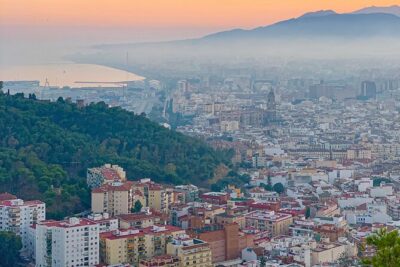
Ancient Malaga comes to life on foot. This self-guided walk uses VoiceMap GPS plus recorded English audio, and it’s easy to follow while you wander through churches and squares. I also like how the pace leaves room to pause and take your time—especially around the old-town food stops like Las Bodegas El Pimpi. One possible drawback: the route is fixed, so if you’re hunting for a specific Roman highlight like the colosseum, it’s not built into this itinerary.
For $9.99 per person, you get lifetime access, offline audio/maps, and a route that fits neatly into a 45-minute to 1-hour window. It’s also designed as a private experience for your group, even though you’ll be walking it on your own.
You start near the port at Estatua del Cenachero and end at Plaza de la Constitución, so you get a clean loop through central Malaga. The app does the heavy lifting with directions and audio timing, which makes this a great first-day option when you want to get your bearings fast.
In This Review
- Key things to know before you walk
- How the VoiceMap Ancient Malaga walk really works (in 45–60 minutes)
- What to bring (and what you won’t need to plan)
- Plaza de la Marina to Manquita: the core old-town spine you’ll remember
- Churches and Islamic-influenced details: the “blend” theme that makes Malaga click
- Picasso stops you can enjoy without turning your day into a ticket line
- Teatro Romano and Alcazabilla: Roman bones under Moorish shadows
- Tapas culture stops: El Pimpi and Plaza de Uncibay as social history
- Art and culture near the finish: Thyssen, Ateneo, and Teatro vibes
- Value check: is $9.99 actually a good deal?
- Should you book this self-guided Ancient Malaga history tour?
- FAQ
- Is this tour fully self-guided?
- How long does the Ancient Malaga history tour take?
- What do I need to use the tour?
- Do I need mobile data during the walk?
- Where does the tour start and end?
- Can I get a refund if I cancel?
Key things to know before you walk
- GPS-guided audio: The route tracking is built to keep you moving without constant map checks.
- Offline-ready: You get downloadable audio, maps, and geodata in the VoiceMap app.
- English narration only: All the audio is provided in English.
- Old-town highlights in one loop: You’ll pass cathedral, Roman theater, Moorish-influenced churches, and Picasso-area sights.
- Short but not rushed: Plan about 45 minutes to an hour, with time to stop for a look.
- No tickets needed to enjoy most stops: Many highlights are view-from-the-street moments.
How the VoiceMap Ancient Malaga walk really works (in 45–60 minutes)
This is a self-guided history experience, so no guide is walking next to you. You load the VoiceMap app on your phone, put on headphones, and press play when you’re at the start point.
The payoff is control. You can slow down in front of churches, step aside to read the atmosphere around a square, or grab a quick bite idea near the tapas stops. The route is designed to be short enough that it doesn’t feel like a long tour commitment, but long enough to cover the “greatest hits” of central Malaga.
You can also read our reviews of more guided tours in Malaga

What to bring (and what you won’t need to plan)
You will need:
- A smartphone
- Headphones
You do not need:
- Transportation (the route is walkable)
- Food included (the tour points out food culture, but it’s on you to choose what and where)
So if you’re the type who likes to keep your day flexible—this works well. You’re not locked into a meal schedule, and you’re not scrambling to find the next stop every two minutes.
Plaza de la Marina to Manquita: the core old-town spine you’ll remember
You begin at Estatua del Cenachero in Plaza de la Marina, right by Malaga’s port area. The audio starts by flagging the fisherman statue and why the humble fish vendors matter in the city’s story. It’s a nice way to ground the history in everyday life instead of only marble-and-royalty.
From there, you pass through Plaza de la Marina, one of the central squares that still feels like the city’s daily heartbeat. Even with modern crowds around you, the narration connects this space to the older layers underneath.
Next comes Plaza del Obispo, a classic old-town corridor moment. This is the kind of stop where you’re not “entering” something so much as absorbing how the streets and public spaces shaped daily movement—who walked where, and why certain religious buildings became anchors.
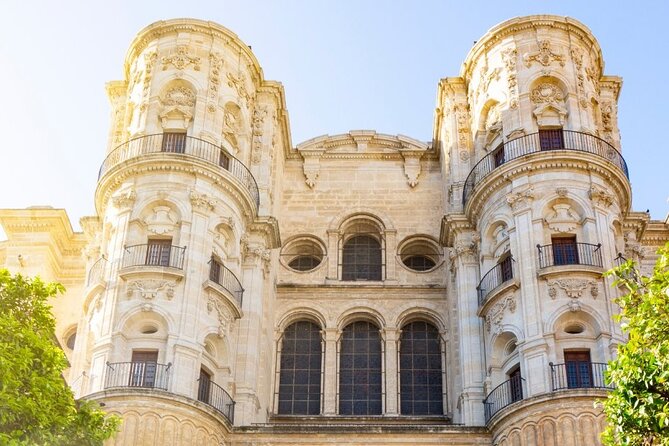
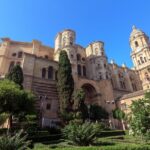
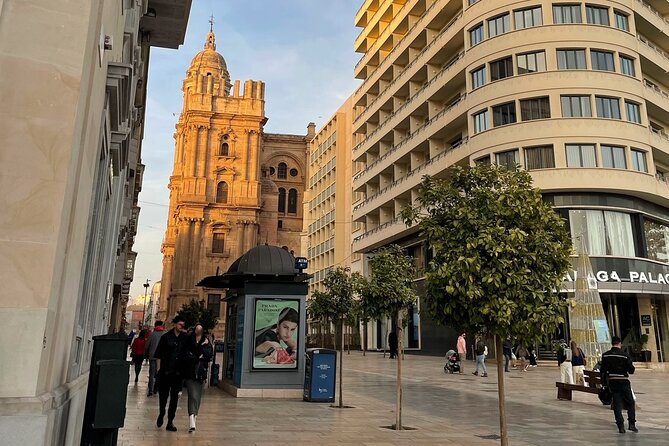
Then you reach Malaga’s cathedral area: the Catedral de Málaga, nicknamed Manquita. The audio explains why locals use that affectionate name and how the building’s look and story fit into the city’s long timeline. Even if you just slow down for a photo and a look from the outside, it’s worth giving this a few minutes because the nickname adds personality to a landmark that can otherwise feel like just another church façade.
After that, you pass Iglesia de San Agustín (Church of St Augustine). The narration points to its Catholic atmosphere with Moorish-influenced traces. In other words: you get a visual reminder that Malaga’s story isn’t one culture stacked on another—it’s more like overlap, blending, and reuse.
Practical tip: if you want the best photos, step off the main walkway briefly. These stops are close together, and the angle often improves when you step back from the crowd.
Churches and Islamic-influenced details: the “blend” theme that makes Malaga click
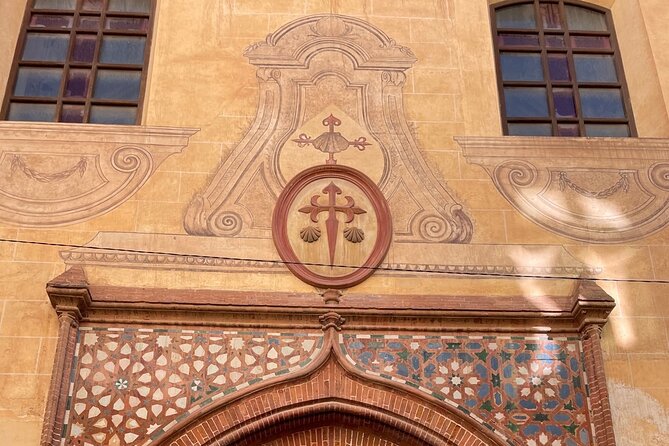
If you like history you can see with your eyes, the stop-by-stop approach helps. After San Agustín, you’re guided toward another Catholic church with Islamic influences: Parroquia Santiago Apóstol Málaga.
The audio uses this church to reinforce a theme you’ll keep seeing in Malaga: the city isn’t just Christian landmarks or just Moorish landmarks. It’s the overlap—sometimes subtle, sometimes obvious in the shapes, materials, and the way buildings sit in the streets.
This is also where a self-guided tour shines. You can linger as long as you want. If you like stepping into quiet spaces, you can take your time near the churches without feeling like you’re falling behind.
Picasso stops you can enjoy without turning your day into a ticket line
Malaga’s Picasso footprint is everywhere in this route, and the good news is you don’t need to buy every ticket to feel the theme.
You catch a glimpse of the Picasso Museum Málaga from the street as you move through the historic core. Then you head toward Plaza de la Merced, the square where Picasso was born and grew up. Here the narration adds a specific detail: the story about Picasso’s survival at birth. It’s the kind of human, slightly dramatic element that makes an artist biography feel less like a textbook.
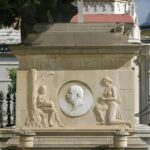
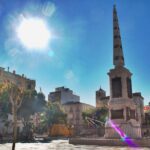
A little farther along you’ll pass Monumento a Torrijos, a monument tied to Spanish liberal history. This break from the art focus is smart. It reminds you that Malaga’s identity isn’t only artists and architecture—there were political currents too.
Then look out for Estatua de Picasso, a direct nod to the city’s most famous son. Nearby, you pass Museo Casa Natal de Picasso, the museum connected to Picasso’s childhood home. Even if you don’t go in, these quick moments help you understand the geographic “map” of his early life.
The route also includes Teatro Cervantes, where the cultural atmosphere picks up again. This is one of those places where the façade and surrounding streets give you a sense of how arts and public life have always lived side-by-side in central Malaga.
You can also read our reviews of more historical tours in Malaga



Teatro Romano and Alcazabilla: Roman bones under Moorish shadows
The walk turns more dramatic as you approach the Roman and fortress-side areas.
You’ll pass Plaza de la Juderia, a square with atmosphere tied to Malaga’s Jewish quarter history. The story here is all about daily life and neighborhood identity—what a square means when communities have shaped it over centuries.
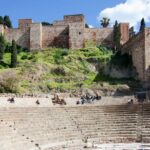
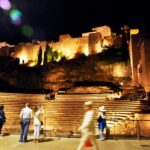
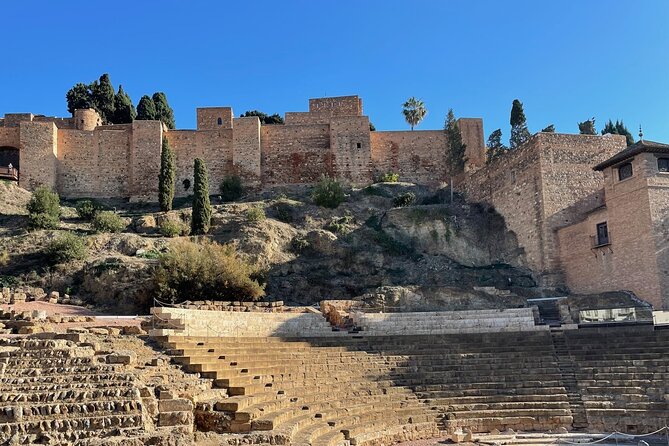
Then comes Teatro Romano de Málaga, the ancient Roman theater. This is one of the clearest “old-city proof points” on the route. Even from the outside and through the surrounding view lines, it’s hard not to feel the scale and permanence of Roman urban planning.
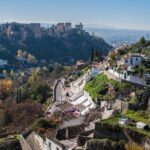
From the theater zone, you head along Alcazabilla, a street that gives you a view toward the Alcazaba fortress. The audio uses this stretch to connect architectural charm with military and defensive history. It also helps you understand why people built up and outward here: terrain, views, and control all mattered.
Next you pass Parroquia Santiago Apóstol Málaga again in the flow of the day, tying back to the blend of influences you’ve already started noticing.
If you like panoramic moments, this is where you’ll usually slow down without needing to be told. Give yourself an extra minute or two so you can actually look at the fortress relationship to the city streets below.
Tapas culture stops: El Pimpi and Plaza de Uncibay as social history
One thing I really like about this tour is that it doesn’t treat food as an afterthought. It flags classic places so you understand them as part of the city’s story.
You get a glimpse of Las Bodegas El Pimpi, one of Malaga’s old tapas bars. The tour notes its historical significance but keeps it outside-focused—you’re not being asked to stop inside unless you want to. That’s a practical choice. You can use the moment as a cue for lunch or a quick snack break.
Later, you stroll near Plaza de Uncibay, where tapas bars and restaurants keep the square’s energy alive. This is the “yes, I can live here” part of the walk. You see how the city’s social life still centers around public spaces, not just museums.
Then the route passes Iglesia de los Santos Mártires Ciriaco y Paula (Church of the Holy Martyrs Ciriaco and Paula). It’s another reminder that religious architecture isn’t separate from everyday street life. In Malaga, it’s woven into it.
Art and culture near the finish: Thyssen, Ateneo, and Teatro vibes
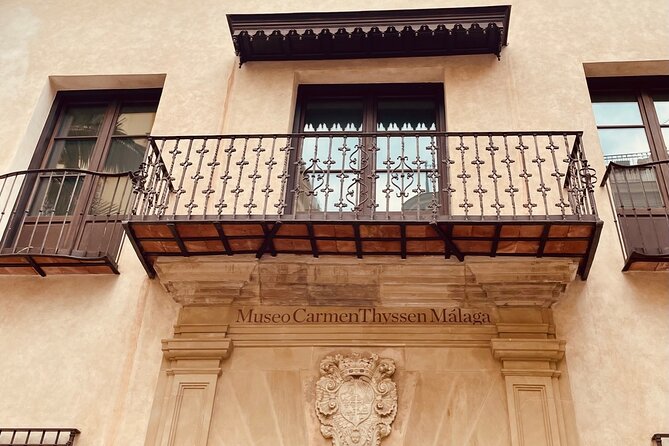
As the walk heads toward the end, you’ll notice more “culture by proximity” moments.
You’ll pass Museo Carmen Thyssen Málaga—again, street-level recognition rather than a mandatory ticket stop. If you love art museums, it’s an easy checkpoint to remember for later. If you don’t, it still works as a marker of how central art is to Malaga’s identity.
Next comes Ateneo de Málaga, a cultural center that was once the San Telmo School of Fine Arts. The narration includes a detail about Picasso’s father teaching drawing there. That connection is useful because it reframes Picasso not as a one-off genius who appeared out of nowhere, but as someone connected to local teaching and creative training.
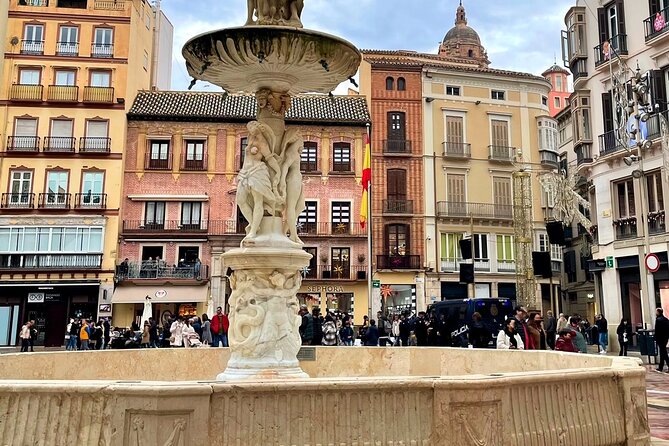
Finally, you finish at Plaza de la Constitución, where the audio shares insights into the origins of the square’s name. It’s a clean wrap-up point: a public space that helps you remember what you walked through and why it matters.
Value check: is $9.99 actually a good deal?
For $9.99, this is strong value because you’re not paying for a specific guide’s time inside a locked schedule. You’re paying for:
- lifetime access
- recorded English narration
- offline audio, maps, and geodata
- a route that compresses a lot of central Malaga into about an hour
If you’re traveling with a tight timeline, self-guided tours like this can save you from over-planning. You also get a practical option when you’re tired. Instead of forcing yourself into one more big group tour, you can do this at a comfortable pace.
The only financial “watch-out” is what’s not included: you supply your smartphone and headphones. If you forget those, you can’t use the tour.
Should you book this self-guided Ancient Malaga history tour?
Book it if:
- You want a short, walkable history route in central Malaga
- You like audio guidance with GPS tracking that keeps you oriented
- You’d rather spend your energy looking and learning than comparing tickets and schedules
- You’re okay with mostly exterior passes and a few pause-and-look moments
Skip it or pair it differently if:
- You’re planning multiple walking tours in the same day and don’t want overlap
- You’re specifically hunting a particular Roman stop that isn’t on this loop
- You prefer a live guide style with Q and A and deeper inside access
If you’re visiting Malaga for the first time and want to connect the dots between port life, cathedral landmarks, Picasso geography, and Roman-era traces, this is a smart way to start.
FAQ
Is this tour fully self-guided?
Yes. It’s a self-guided audio walk. You use the VoiceMap app for the narration and route guidance while you walk on your own.
How long does the Ancient Malaga history tour take?
Plan about 45 minutes to 1 hour, approximately.
What do I need to use the tour?
You’ll need a smartphone and headphones. The tour includes the VoiceMap app experience, but your phone and audio gear are not provided.
Do I need mobile data during the walk?
No. The tour includes offline access to audio, maps, and geodata.
Where does the tour start and end?
It starts at Estatua del Cenachero on Plaza de la Marina and ends at Plaza de la Constitución.
Can I get a refund if I cancel?
No. The experience is non-refundable and cannot be changed for any reason.