REVIEW · MALAGA
English Cemetery Tour
Book on GetYourGuide →Operated by LUPYTOURS · Bookable on GetYourGuide
A cemetery tour can sound gloomy, until you see the details. This one in Málaga turns funerary art into a clear, walking story—terraces, notable graves, and symbols you’ll actually know how to read. I especially love the way it mixes big-name drama with small, explainable details, and how the guide points out things like the Angel of Anna without making it feel like a lecture. One consideration: it’s a hilly, terraced cemetery, so comfortable shoes matter and it won’t suit everyone.
You’ll start right at the entrance gate and move through the courtyards like you’re following a timeline carved in stone. I like that the tour is focused and efficient (about two hours of walking), and it’s priced as an easy add-on at $11 with cemetery entry included. The main drawback is that it’s led in Spanish, so if you don’t follow Spanish well, you might miss some of the storytelling.
If you’re the type who enjoys meaning in details—names, motifs, monuments—this is a great change from the usual “look and move on” sightseeing.
In This Review
- Key things I’d plan around
- Málaga’s English Cemetery: a walking history lesson you can actually use
- Starting at the entrance gate: you get the map before the maze
- Terraces and courtyards: how burial types and families come into focus
- Robert Boyd and the Gneisenau story: tragedy with names attached
- The Angel of Anna and the language of symbolism
- Prominent figures: William Mark, the first burial, and why placement matters
- Ending at Casa del Guarda: a calm close at the entrance
- Value and timing: $11, one day, and why it works as a side trip
- Language, guides, and what to expect from the storytelling
- What to bring (and what to leave at home)
- Who this tour suits best
- Should you book the English Cemetery Tour in Málaga?
- FAQ
- How long is the tour?
- Where does the tour start?
- How much does it cost?
- Is the tour guided?
- What should I bring?
- Is food provided?
- Is this tour suitable for wheelchair users or mobility impairments?
- What’s the language of the tour content?
Key things I’d plan around
- First English cemetery in Spain, explained in plain terms so the place doesn’t stay mysterious.
- Tragic case files in stone—including Robert Boyd and the sinking connected to the frigate Gneisenau.
- Symbol-reading for visitors: you’ll learn what to look for, like the memorial bench and the red poppy.
- Standout funerary art: the Angel of Anna plus Celtic crosses that reward close looking.
- A real garden feel rather than a quick pass, with terraces and courtyards you’ll navigate on foot.
Málaga’s English Cemetery: a walking history lesson you can actually use
There’s a special kind of calm in a cemetery that’s also a museum without the museum vibe. At Cementerio Inglés de Málaga, the “city of the dead” is shaped by the same human impulses you see in daily life: status, grief, memory, and community. What makes this tour satisfying is that it doesn’t treat the graves like background scenery. It treats them like evidence.
I like that you’re shown how the living built a social world here—and how that world shows up in the layout and the memorials. Terraces and courtyards aren’t just scenic steps; they help explain how different burials and notable families are organized. You’ll start at the entrance gate with a brief historical intro, and it sets you up to understand what you’re looking at instead of just admiring it.
Another thing I appreciate: the tour name is practical. This isn’t a generic “cemetery walk.” It’s specifically about the first English cemetery in Spain, which gives you a clear theme. And within that theme, the guide threads together biography and symbolism—names like Robert Boyd and William Mark, plus the visual language carved into markers and headstones.
You should also know the tone. This isn’t all dark. It’s often curious, sometimes surprising, and occasionally almost dramatic in how the guide frames the stories. If you like your history with plot points, you’ll probably enjoy it.
You can also read our reviews of more tours and experiences in Malaga.



Starting at the entrance gate: you get the map before the maze
The tour begins at the cemetery entrance, where you get a historical introduction to the site’s tragic beginnings. That first chunk matters. Cemeteries can feel overwhelming because there’s so much visual information. A good start helps you understand what counts as “important” here and why.
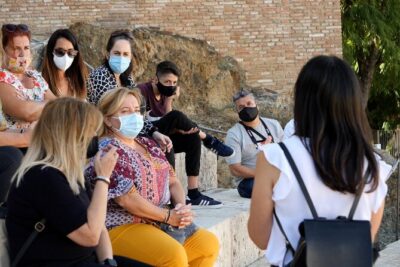
You’ll then walk into the terraces and courtyards, guided at a pace that gives you time to look. The itinerary is built around seeing patterns: types of burials, prominent figures and families, and recurring symbolism. The guide doesn’t just point at a grave and move on. They explain what you’re looking at and what question it answers.
Meeting is simple: the guides meet you at the cemetery with blue umbrellas. If you’re trying to keep the day smooth, this is one less thing to worry about when you arrive in Málaga.
Two practical notes for the route itself:
- The cemetery includes slopes and terraces, so expect uneven ground and uphill/downhill sections.
- The walking time during the tour is about two hours, which is long enough to feel the terrain if you’re not wearing proper shoes.
Terraces and courtyards: how burial types and families come into focus
Once you’re inside, the tour becomes a guided walk through sections of the cemetery. Terraces and courtyards are used like chapters. As you move, you’ll get help understanding how different burials are arranged and how prominent families show up in the landscape.
This is where the experience becomes more than “pretty stones.” You start asking better questions:
- Who was the first person buried?
- Which names keep repeating for the right reason?
- How does the placement relate to community memory?
That’s also where you learn a few standout details tied to visitors’ questions. The tour includes a guide to prominent elements such as the memorial bench and the red poppy. Those aren’t just decorative features; they’re symbols the guide helps you interpret so your photos won’t feel like random snapshots later.
I also like that the guide highlights prominent figures and families important to the city. That gives you context for why an English cemetery exists in Málaga at all, and why certain stories ended up preserved here in stone.
Robert Boyd and the Gneisenau story: tragedy with names attached
One of the best parts of this tour is that it handles tragedy in a way that stays personal. You don’t just hear that something bad happened. You hear it connected to specific people and specific references—like Robert Boyd, and the sinking tied to the frigate Gneisenau.
Stories like this matter for two reasons. First, they turn monuments into more than artwork. Second, they teach you how to connect names on stones to historical events, even if you don’t know the history before you arrive.
The guide walks you through these stories while you’re physically near the relevant memorials and features. That timing helps. It’s much easier to remember a name when you’re standing in the same place where the cemetery’s memory is expressed.
A small piece of advice: if you’re a note-taker, bring a pen and jot key names. The tour includes questions you might not expect—like who was the first person buried—and it’s the kind of information that sticks when you write it down once.
The Angel of Anna and the language of symbolism
Cemeteries are often described as symbolic, but many tours treat symbolism like a vague vibe. Here, you’re shown actual symbols and how to interpret them. One standout is the Angel of Anna, described as the most beautiful angel on the tour. You’ll also hear about Celtic crosses, and you’ll learn what funerary symbolism means in practice—how it communicates beliefs, identity, and mourning.
This is where I think you’ll get the most value if you enjoy looking closely. The guide helps you read the cemetery the way you’d read a signpost. Instead of wondering what the decorative details are trying to say, you learn what to look for and why it’s there.
From the guide-led approach, it sounds like you’ll also pick up practical ways to interpret images on the tombs. That’s a rare skill in travel experiences. You usually leave with a few facts. Here, you’re leaving with a method: you’ll know what symbols to ask about next time you see them.
If you want a clean goal for your visit, make it this: plan to slow down for the Angel of Anna. The rest of the tour makes more sense when you’ve seen the most memorable piece of funerary art and learned what it’s communicating.

Prominent figures: William Mark, the first burial, and why placement matters
You’ll cover more than the headline tragedy. The tour also points out prominent individuals and families who were important to the city. Among the specific names and questions highlighted:
- Who was the first person buried
- Who’s William Mark
- How certain sections reflect who the community considered notable
These details matter because they make the cemetery feel like a place with a living social fabric, not just a “tour stop.” You’re seeing how memory works. Names get preserved. Families get recognized. Some stories become anchors.
The guide’s job is to connect these people to the physical layout you’re walking through. That’s why the terraces and courtyards are so important. You’re not only hearing facts—you’re learning how to “locate” those facts in the cemetery’s geography.
Ending at Casa del Guarda: a calm close at the entrance
The tour ends where it started: at the cemetery entrance, at the place called Casa del Guarda. That closing location isn’t just convenient. Finishing at a known landmark gives your brain a “reset point” before you leave, so the experience doesn’t blur together.
By the end, you should feel like you understand the cemetery as a planned space—terraced, symbolic, and shaped by real historical events. You’ll also likely notice how much information you missed before the guide started pointing it out.
If you’re taking photos, do it with intention. Aim for the angel features, Celtic crosses, and the memorial elements your guide mentions (like the memorial bench and the red poppy). If you shoot everything blindly, you’ll end up with a camera roll full of stones but not enough context.
Value and timing: $11, one day, and why it works as a side trip
At $11 per person, this is priced like a low-stress cultural add-on. The key reason it feels like good value is that cemetery entrance is included. Add in the guided storytelling and the fact that you’ll skip the ticket line, and you get a straightforward “pay once, learn a lot” experience.
The tour is short. It’s designed to fit into your day without stealing half your vacation. You should plan for about two hours of walking during the tour, plus the time spent stopping for key areas. The schedule is compact enough that you can pair it with other Málaga sights afterward.
Also, no food is provided. So if you’re doing this mid-day, decide in advance where you’ll grab lunch. I’d rather you spend your brain power listening to the guide than thinking about hunger.
Language, guides, and what to expect from the storytelling
This is a live guided tour in Spanish. Some content is shown in its original language, so even if you’re not fluent, you can still follow visually because the tour is anchored in monuments and symbolism. That said, the storytelling is the main event, so Spanish helps a lot.
One of the most praised parts of the experience is the guide. Names you’ll see connected to great tours include Loli, described as close, attentive, and funny, and also clearly expert. That combination is exactly what makes this kind of tour work. It’s one thing to know cemetery symbolism. It’s another to explain it in a way that feels friendly and easy to remember.
If you’re worried about understanding Spanish, focus on the visual cues the guide references. The whole experience is built around what’s in front of you—terraces, prominent figures, specific memorial elements, and the Angel of Anna—so you’re not trapped in a classroom script.
What to bring (and what to leave at home)
For a smooth walk through slopes and terraces, pack smart:
- Comfortable shoes
- Umbrella
- Water
Don’t plan on bringing certain items. The tour rules list restrictions including pets, weapons or sharp objects, and drones. There are also limitations on what cameras you can use: waterproof cameras are not allowed. And to keep the cemetery respectful, you’re expected not to litter and to avoid touching restricted areas.
If you’re the type who always has a full kit, scale it down. This tour is about walking and looking, not carrying a lot of gear.
Who this tour suits best
This is a great match if you:
- Like stories tied to specific places and names
- Enjoy learning symbolism and noticing details
- Want a quieter, culture-forward activity that’s different from the usual big-ticket sights
It may not be the best fit if you:
- Need step-free access (the cemetery has slopes and terraces)
- Use a wheelchair or have mobility impairments, since it’s listed as not suitable for wheelchair users
- Prefer tours in English only, since it’s guided in Spanish
Should you book the English Cemetery Tour in Málaga?
Book it if you want something memorable for the right reasons. At $11 with entrance included and a guided focus on symbolism, it’s one of those rare tours that makes a “different” destination feel readable. The standout attractions—Robert Boyd, the Gneisenau-connected tragedy, the Angel of Anna, Celtic crosses, and those symbolic details like the memorial bench and the red poppy—aren’t just facts. They’re the tools your brain will use to interpret the cemetery after the tour ends.
Skip it only if you strongly need step-free access or you can’t manage a Spanish-language experience. Otherwise, this is exactly the kind of small-group, story-led walk that makes travel feel personal.
FAQ
How long is the tour?
The walking time during the tour is about 2 hours, and the overall experience is listed as 1 day. Check available starting times when you book.
Where does the tour start?
The tour starts at Cementerio Inglés de Málaga.
How much does it cost?
It’s $11 per person, and cemetery entrance is included.
Is the tour guided?
Yes. It’s a live guided tour in Spanish, and guides are at the meeting point with blue umbrellas.
What should I bring?
Bring comfortable shoes, an umbrella, and water.
Is food provided?
No food is provided on the tour.
Is this tour suitable for wheelchair users or mobility impairments?
No. The cemetery has slopes and terraces, and it’s listed as not suitable for people with mobility impairments or wheelchair users.
What’s the language of the tour content?
The tour guide speaks Spanish, and some content may be shown in its original language.